



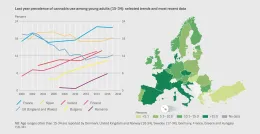
Infographic: last year prevalence of cannabis use among young adults (15-34): selected trends and most recent data

Explore the most recent data on the drug situation in Europe provided by the EU Member States. These datasets underpin the analysis presented in the agency's work. Most data may be viewed interactively on screen and downloaded in Excel format.

We work closely with the 27 EU Member States plus Norway and Türkiye, candidates and potential candidates to the EU, the European Neighbourhood Policy countries and other third countries.

The content in this section is aimed at anyone involved in planning, implementing or making decisions about health and social responses.

Explore our wide range of publications, videos and infographics on the drugs problem and how Europe is responding to it.

The European Monitoring Centre for Drugs and Drug Addiction (EMCDDA) is the leading authority on illicit drugs in the European Union.
The EMCDDA uses five key epidemiological indicators to achieve its goal of providing factual, objective, reliable and comparable information on drugs and drug addiction at European level. These indicators have been developed by the Centre in close collaboration with the Reitox network, experts across Europe and with other international organisations competent in the field of drugs and drug addiction.

The EMCDDA's five key epidemiological indicators are listed below:
Publications by the EMCDDA on this topic


Photos, infographics and videos from our Media library


