
EMCDDA Home
Search

Country overview: Portugal

Contents

Key figures
  Year Portugal EU (27 countries) Source
Population 2010 10 637 713 p 501 105 661 p Eurostat
Population by age classes 15–24 2010 11.1 % 12.1 % p Eurostat
25–49 37.2 % 35.8 % p
50–64 18.6 % 19.1 % p
GDP per capita in PPS (Purchasing Power Standards) 1 2009 80 p 100 Eurostat
Total expenditure on social protection (% of GDP) 2 2008 24.3 % 26.4 % p Eurostat
Unemployment rate 3 2010 11.0 % 9.6 % Eurostat
Unemployment rate of population aged under 25 years 2010 22.4 % 20.9 % Eurostat
Prison population rate (per 100 000 of national population) 4 2009 104.4   Council of Europe, SPACE I-2009
At risk of poverty rate 5 2009 17.9 % 16.3 %  SILC

p Eurostat provisional value.

1 Gross domestic product (GDP) is a measure of economic activity. It is defined as the value of all goods and services produced less the value of any goods or services used in their creation. The volume index of GDP per capita in Purchasing Power Standards (PPS) is expressed in relation to the European Union (EU-27) average set to equal 100. If the index of a country is higher than 100, this country's level of GDP per head is higher than the EU average and vice versa.

2  Expenditure on social protection contains: benefits, which consist of transfers, in cash or in kind to households and individuals to relieve them of the burden of a defined set of risks or needs.

3 Unemployment rates represent unemployed persons as a percentage of the labour force. Unemployed persons comprise persons aged 15 to 74 who were: (a) without work during the reference week; (b) currently available for work; (c) actively seeking work.

4 Situation of penal institutions on 1 September, 2009.

5 Share of persons aged 0+ with an equivalent disposable income below the at-risk-of-poverty threshold, which is set at 60 % of the national median equivalised disposable income (after social transfers).

Drug use among the general population and young people

The first general population survey on drug use was conducted in Portugal in 2001. A sample of 15 000 individuals representative of the Portuguese population was surveyed. The results revealed that 7.8 % of respondents aged 15 to 64 had used an illegal drug at least once in their lives (lifetime prevalence). The most-reported substance in this context was cannabis (7.6 % lifetime prevalence). The use of other illegal substances was less frequently reported. Lifetime prevalence was less than 1 % for cocaine, heroin, ecstasy, amphetamines and LSD. Gender differences concerning illegal drugs experimentation were found for all substances. A higher proportion of males than females had used these substances at least once (11.5 % vs 3.9 % for cannabis, 1.2 % vs 0.2 % for heroin and 1.5 % vs 0.3 % for cocaine). The second national survey, carried out among the general population in 2007, a sample of 12 202 individuals representative of the Portuguese population was surveyed. Results show that 12 % of respondents aged 15 to 64 had used an illegal drug at least once in their lives (lifetime prevalence). The most reported substance in this context was cannabis (11.7 % lifetime prevalence). Lifetime prevalence was less than 1 % for amphetamines, LSD and hallucinogenic mushrooms; for cocaine (1.9 %), heroin (1.1 %) and ecstasy (1.3 %). Gender differences concerning illegal drugs experimentation were found for all substances. A higher proportion of males than females had used these substances at least once (18.4 % vs. 5.2 % for cannabis, 1.8 % vs. 0.4 % for heroin and 3.2 % vs. 0.7 % for cocaine).

Surveys among young people attending school are currently carried out in Portugal nearly every two years: the National School Survey (Inquérito Nacional em Meio Escolar — INME) in 2001 and 2006 (a former version of the national survey was done in 1989 and 1995); and the ESPAD international school survey every four years since 1995 (students born 16 years before the year of data collection). Also, the Health Behaviour in School-aged Children a survey promoted by the World Health Organization (HBSC/WHO) is repeated every four years in Portugal and targets young people in school settings (6th, 8th and 10th grades).

In 2006, results from national studies implemented in the context of school populations, HBSC and INME, reveal decreases in the consumption in this target population, respectively between 2002–06 and 2001–06, with cannabis being once more the drug with higher prevalence of use between these populations.

The ESPAD survey results of 2007 showed that the lifetime prevalence for cannabis use was 13 % (compared to 18 % in 2003, 12 % in 1999). As regard to other drugs, the lifetime prevalence for inhalants was 4 % (8 % in 2003, 3 % in 1999), for all other substances lifetime prevalence was below 2 %. Results indicated 10 % for the last year prevalence of cannabis use (13 % in 2003, 9 % in 1999), 6 % for the last month prevalence of cannabis (8 % in 2003, 5 % in 1999).

top of page

Prevention

The Portuguese ‘National plan against drugs and drug addiction 2005–12’ aims to: (i) increase the number of drug prevention programmes based on scientific evidence; (ii) increase the number of selective prevention programmes directed to vulnerable groups; and (iii) improve the process of selection, monitoring and evaluation of prevention programmes. In the framework of the National Plan Against Drugs and Drug Addiction 2005–12, the Operational Plan of Integrated Responses (PORI) is an intervention framework targeted at drug demand reduction and organised at a local/regional level. The principles are: (i) to integrate responses; (ii) to profit from synergies at local level; (iii) to empower citizens; and (iv) to promote their participation in partnerships that address identified needs of the community. Thus, in each specific territory, an intervention may address different problems and bring together different partners, working in different settings, depending on the identified needs. Within PORI, the most vulnerable territories have been mapped in order to prioritise them for resource and intervention allocation. This allowed identifying 163 territories in continental Portugal where a pressing development for an integrated intervention was needed. An identified territory does not match administrative delimitations, but several places related between themselves by the existence of common problems associated with the use of psychoactive substances, that need responses at several levels (prevention, treatment, harm and risk reduction, and reintegration).

Universal drug prevention is part of the Portuguese school curriculum. Prevention programmes are delivered through training sessions, awareness-raising activities and dissemination of information through printed material. In the ‘Safe school programme’, law enforcement agents patrol the areas surrounding schools to prevent and protect from criminal activities such as drug trafficking in the surrounding area and are also involved in awareness and training activities in teaching establishments (targeting students, parents, school staff and law enforcement agents). Drug prevention activities aimed at university students, in vocational education settings and in workplaces are usually implemented within the framework of comprehensive health promotion programmes.

Selective prevention is given high priority from both a political and practical perspective through the Program of Focused Intervention (PIF) with 23 projects. The PIF envisages selective preventive interventions in the drug addiction area, based in scientific evidence, dealing with problematic specific groups, namely families, vulnerable children and youngsters and individuals with patterns of use in recreational settings. In some areas, small but important steps were given to improve the intervention, particularly in the development of guidelines with regard to the care of young users of psychoactive substances, including alcohol, and in the intervention on recreational settings.

Searching for the ‘family treasure’ is a well researched selective programme for vulnerable families.

All government financed prevention interventions are monitored.

top of page

Problem drug use

Portugal has carried out four new multiplier-methods estimates based on the 2005 data, which were then compared to previous estimates based on the 2000 data. The size of the population of long-term and/or regular users of opiates, cocaine and/or amphetamines was estimated to be between 4.3 and 5.0 per 1 000 inhabitants aged 15–64 (30 833 to 35 576 individuals) using an outreach team multiplier. A broader definition, not restricting the population to long-term and regular users, calculated using a treatment multiplier, suggested a higher rate of 6.2–7.4 cases per 1 000. Injecting drug users were estimated at 1.8–2.2 per 1 000 inhabitants aged 15–64 using a treatment multiplier, and 1.5–3.0 using a mortality multiplier. In all cases, the 2005 estimates were lower than those from 2000, however, in all cases except in the estimate of injecting drug users calculated using a mortality multiplier, the confidence intervals for the estimates in 2005 and 2000 overlapped.

The EMCDDA defines problem drug use as intravenous drug use (IDU) or long duration/regular drug use of opiates, cocaine and/or amphetamines. Ecstasy and cannabis are not included in this category.

top of page

Treatment demand

Treatment demand data in Portugal is collected through the outpatient public network. In 2009, the network received treatment demand data from all 79 outpatient public treatment centres across Portugal. Data were available only on clients who entered treatment for the first time in their life (new clients) and not on all those who entered treatment in 2009.

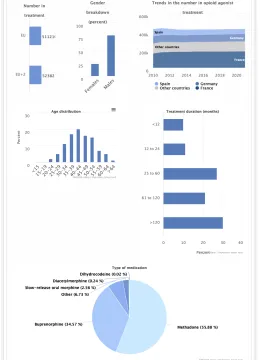
In 2009, 7 643 were in treatment for the first time in their life. Among first-time treatment clients, 55.8 % reported opioids as their main substance followed by 11.7 % for cannabis and 8.7 % for cocaine and. In 2009, 49 % of new treatment clients were more than 35 years of age indicating ageing of the drug users population. With regards to gender distribution, 84 % were males whereas 16 % were females.

top of page

Drug-related infectious diseases

In Portugal, global estimations of the prevalence of infectious diseases among drug users are not available. However, some data concerning clients of some treatment facilities are available, and can provide information on rates among some sub-groups of drug users: (i) those demanding treatment for the first time at the outpatient treatment public network; (ii) those submitted to a detoxification treatment in public or certified private detoxification units; or (iii) those in treatment in public or certified private therapeutic communities.

In 2009, 7 % of drug users treated for the first time who were willing to present test results, were found to be HIV positive. The proportion of first time drug users presenting tests differed amongst the treatment environments. 33 % of outpatient first treatments submitted tests, 88 % from public or certified private detoxification units, and 83 % from public or certified private therapeutic communities. For the same treatment environments, rates for acute hepatitis B infections were 2 %, 3 % and 3 % and for hepatitis C, 29 %, 50 % and 40 % respectively (with 20 %, 90 % (92 % for HCV) and 82 % of the respective totals being tested).

When interpreting these results, it should be taken into consideration that the sample of tested drug users at various services is not always representative of the group. It must also be mentioned that some of the treatment samples included IDUs and non-IDUs, and consequently the rates among IDUs will probably be higher than those presented.

In general, a decreasing trend in the percentage of drug users in the total number of notifications of HIV and AIDS cases continues to be registered (since 1999–2000). Likewise, the decline in the incidence of HIV and AIDS among IDUs is also registered since 1999–2000 (142 new HIV cases in 2009 and 1 482 in 2000; 70 new AIDS cases in 2009 and 675 in 1999). A downward trend can be observed also in the prevalence of HIV, HCV and HBV among clients of the drug treatment settings.

top of page

Drug-related deaths

There are two sources of information about drug-related deaths in Portugal: the General Mortality Registry of the Statistics National Institute and the Special Registry of the National Institute of Forensic Medicine.

In 2009, the General Mortality Registry of the Statistics National Institute registered 27 cases of drug-related deaths, representing an increase in comparison to 2008 (20 cases) which may be a reflect of the increase in the number of deaths and of the methodological improvements on the general mortality registries.

In 2009, the provisional data from the Special Registry of the National Institute of Forensic Medicine estimate 54 drug-related death cases (selection D) in Portugal. Majority of death cases occurred among men, at mean age of 38 years. All the provisionally reported DRD cases were toxicologically confirmed and 90.7 % of them were linked to opiates.

top of page

Treatment responses

Healthcare for drug users is organised in Portugal mainly through the public network services of treatment for illicit substance dependence, under the Institute on Drugs and Drug Addiction and the Ministry of Health. In addition to public services, certification and protocols between NGOs and other public or private treatment services ensure a wide access to quality-controlled services encompassing several treatment modalities. The public services provided are free of charge and accessible to all drug users who seek treatment.

Drug treatment in Portugal can be classified into four main categories: (i) outpatient drug treatment; (ii) day care centres; (iii) detoxification units; and (iv) therapeutic communities. All centres provide both psychosocial and substitution treatment. Day centres offering outpatient care are provided by public and non-governmental services. Withdrawal treatment is available in public and private detoxification units. Inpatient psychosocial treatment mostly consists of therapeutic communities and is mainly available in private services. There is also short-term and long-term residential psychosocial drug treatment available. There are 70 specialised treatment facilities (public and certified private therapeutic communities), 13 detoxification units, 79 public outpatient facilities and 9 accredited day centres.

In 2009, the number of guidelines defining early interventions for young people, on follow-up of high-risk groups, on referrals between the programmes and on admission criteria to therapeutic communities were made public, thus systematising the best practice experiences gained in the field.

Substitution treatment is widely available in Portugal, through public services such as specialised treatment centres, health centres, hospitals and pharmacies as well as NGOs and non-profit organisations. Methadone has been made available since 1977, buprenorphine since 1999 and recently also the buprenorphine/naloxone combination.

Decree Law 183/2001 Article 44.1 and Decree Law 15/93 Article 15.1–3 stipulate that methadone treatment can be initiated by treatment centres whereas buprenorphine treatment can be initiated by any medical doctor, specialised medical doctors and treatment centres. Moreover, the provision of buprenorphine in pharmacies started in 2004.

In 2009, 28 708 clients were registered in opioid substitution programmes (25 808 in 2008), 76 % of whom were in methadone maintenance treatment and the remaining clients (24 %) in high dosage buprenorphine treatment.

top of page

Harm reduction responses

The main priorities established by the national plan for the 2005–12 period in the area of risk and harm reduction are: (i) to set up a global network of integrated and complementary responses in the harm reduction area with public and private partners; and (ii) to target specific groups for risk reduction and harm minimisation programmes. A network of harm reduction programmes (syringe exchange, low threshold substitution programmes, etc.) and structures, including drop-in centres, refuges, shelters, contact units and mobile centres, is being consolidated throughout the country in critical zones of intensive drug use with the aim to prevent drug-related risks such as infectious diseases and social exclusion and delinquency.

The National Commission for the Fight Against AIDS (Comissão Nacional de Luta Contra a SIDA), in cooperation with the National Association of Pharmacies (Associação Nacional de Farmácias) implements the national syringe exchange programme ‘Say no to a second-hand syringe’ which was set up in October 1993 to prevent HIV from spreading amongst IDUs. The programme currently involves 1 360 pharmacies (approximately 48 % of all pharmacies on the Portuguese mainland), several mobile units, other public and NGO facilities as well as prison settings. Approximately 45 million syringes have been exchanged through this programme since its launch in October 1993 until December 2009 and in 2009 alone 2.3 million syringes were distributed. Overall trends in syringe exchange show that an increase in syringe numbers until 2001 (total 3.5 million) was followed by a stabilisation on a lower level (2.7 million) until 2005, and a decline thereafter. An evaluation of the programme in 2002 concluded that it had been successful in preventing HIV infections among drug injectors. Regions with the highest population density such as the Lisbon, Porto and Setúbal districts are still those with the higher quantity of exchanged syringes, and have taken part in the programme since its beginning.

top of page

Drug markets and drug-related offences

Heroin seized in Portugal comes mainly from the Netherlands and Spain, cocaine from Brazil, Venezuela and Colombia, cannabis resin from Morocco and herbal cannabis from South Africa. Most of the herbal cannabis and cannabis resin seizures are destined for the external market.

In 2009, a total number of 13 897 reports of persons involved in drug-related offences were reported. Cannabis-related offences accounted for the biggest share with 64.8 %, followed by heroin-related offences with 11.6 %, and 8.0 % refer to cocaine-related offences.

In 2009, the highest number of seizures involved cannabis resin (3 144), followed by heroin and cocaine (1 475 and 1 420 respectively). The number of herbal cannabis (liamba) and ecstasy seizures continue to be much lower. However, an increasing trend in the number of seizures of all drugs can be observed in the last five years, comparing to the first half of the decade.

Concerning the quantities seized, liamba (herbal cannabis) registered in 2009 the highest value ever (approximately 5 045 kg) and cocaine registered the lowest value of the decade (approximately 2 697 kg). In 2009, the quantity of seized heroin doubled when compared to 2007–08 (128 kg seized in 2009, 68 kg in 2008 and 62 kg in 2007).

top of page

National drug laws

The main drug law in Portugal is Decree Law 15/93 of 22 January, which defines the legal regime applicable to trafficking and consumption of narcotic drugs and psychoactive substances. Drug trafficking may be sentenced to one to 12 years imprisonment, depending on different criteria, one of them being the nature of the substance supplied. For users who sell drugs to finance their own consumption, the penalty is reduced.

The Portuguese legal framework on drugs changed in November 2000 with the adoption of Law 30/2000, in place since July 2001, which decriminalised illicit drug use and related acts, but maintains drug use as an illicit behaviour and also maintains the illegal status for all drugs included in the relevant United Nations Conventions. However, a person caught in possession of a small quantity of drugs for personal use (established by law, this shall not exceed the quantity required for an average individual consumption during a period of 10 days), without any suspicion of being involved in drug trafficking, will be evaluated by a local Commission for Dissuasion of Drug Addiction, composed of a lawyer, a doctor and a social worker. Sanctions can be applied, but the main objective is to explore the need for treatment and to promote healthy recovery.

top of page

National drug strategy

The 1999 Portuguese ‘National strategy for the fight against drugs’ defined the general objectives in the drugs field and is currently being implemented through the ‘National plan against drugs and drug addiction 2005–12’, which focuses on four main ideas: geographical proximity, integrated approaches and responses, focus on the citizen, and improving quality and accreditation mechanisms. The objective set for the national plan is to significantly reduce the use of drugs amongst the population and its negative social and health consequences. The national plan is complemented by an ‘Action plan against drugs and drug addiction 2005–08’, which covers the areas of coordination, international cooperation, information/research/training/evaluation, the legal framework, demand reduction and supply reduction, and identifies for each action the party or parties responsible, a timetable and the indicators/assessment instruments to monitor the plan’s implementation.

An internal evaluation of the implementation of this action plan was finished in 2009 and used as a basis for the new action plan 2009–12 which was adopted on 26 May 2010.

top of page

Coordination mechanism in the field of drugs

The overall responsibility for endorsement, coordination and evaluation of the drug policy lies with the Inter-ministerial Council, a coordinating body chaired by the Prime Minister and comprised of different ministers (Justice, Health, Education, Science and Higher Education, Labour, Home Affairs, Foreign Affairs, National Defence, Finances, Environment, Agricultural, Economy and Social Security) and the National Coordinator. The Inter-ministerial Council has set up an Inter-ministerial Technical Commission chaired by the National Coordinator and composed of representatives designated by the Ministers themselves.

The Institute on Drugs and Drug Addiction (IDT) falls under the Ministry of Health and is in charge of implementing the national strategy and the action plan. The President of the IDT is the National Coordinator.

The National Council for the Fight Against Drugs and Drug Addiction is an advisory body, chaired by the Prime Minister that can delegate to the Minister of Health. It is composed of representatives of the Regional Governments of Madeira and Azores, the Judiciary, the General Prosecutor and the civil society, as well as five personalities designated by the Government. It advises the Government on the national strategy and the action plan and follows the implementation reports.

The Criminal Police (Polícia Judiciária) at the Ministry of Justice coordinates interventions and information on the supply reduction area.

top of page

Drug-related research

The external evaluation of the national strategy showed that drug-related research had increased by more than 200 % between 1999 and 2004. The national plan 2005–12 gives priority to the repetition of major epidemiological surveys but also to evaluation, social and economic research which can support the decision-making process in all intervention areas. Most of the research in this field is funded by the IDT, which is also a major actor in undertaking research, together with university departments. Since 2007, a university group of researchers developed a network to discuss and disseminate the work in this area. The IDT, through its website and reports, and national scientific journals are the main dissemination channels for drug-related research findings. Recent drug-related studies mentioned in the 2010 Portuguese National report mainly focused on aspects related to prevalence of drug use.

top of page

About the EMCDDA

The European Monitoring Centre for Drugs and Drug Addiction (EMCDDA) is the reference point on drugs and drug addiction information in Europe. Inaugurated in Lisbon in 1995, it is one of the EU’s decentralised agencies. Read more >>

Contact us

EMCDDA
Cais do Sodré
1249-289 Lisbon
Portugal
Tel. (351) 211 21 02 00
Fax (351) 218 13 17 11

More contact options >>

Page last updated: Tuesday, 15 November 2011